Nan Wang王 南
I am a Founding Robotics Engineer at Chestnut Robotics (formerly TetherIA AI), working on dexterous manipulation, sim-to-real reinforcement learning, and teleoperation systems for tendon-driven hands and humanoid robots.
I received my Ph.D. in Computer Science and Engineering from UC Santa Cruz in 2024, advised by Prof. Ricardo Sanfelice at the Hybrid Systems Laboratory. My dissertation, Provably Correct and Efficient Motion Planning for Hybrid Dynamical Systems, received the 2025 Cyber-physical Systems Research Center Best Dissertation Award.
Prior to UCSC, I obtained my M.S. in Control Science and Engineering from Tongji University and B.E. in Automation from East China University of Science and Technology. I also interned at Mitsubishi Electric Research Laboratories in 2023.
My research spans dexterous manipulation, reinforcement learning, sim-to-real transfer, motion planning, hybrid systems, model predictive control, and SLAM.
News
- Feb 2026 Received the Cyber-physical Systems Research Center Best Dissertation Award at UC Santa Cruz.
- Aug 2025 HyRRT and HySST motion-planning algorithms merged into the Open Motion Planning Library (OMPL).
- May 2025 Joined Chestnut Robotics as Founding Robotics Engineer.
- May 2025 “cHyRRT and cHySST: Two Motion Planning Tools for Hybrid Dynamical Systems” accepted to IEEE CASE 2025.
- Oct 2024 “Motion Planning for Hybrid Dynamical Systems: Framework, Algorithm Template, and a Sampling-based Approach” accepted by The International Journal of Robotics Research (IJRR).
- Aug 2024 Completed Ph.D. in Computer Science and Engineering at UC Santa Cruz.
- Jul 2024 “A Switched Reference Governor for High Performance Trajectory Tracking Control under State and Input Constraint” presented at American Control Conference 2024.
- Jun 2024 “HyRRT-Connect: A Bidirectional Rapidly-Exploring Random Trees Motion Planning Algorithm for Hybrid Systems” presented at 8th IFAC ADHS 2024.
- Dec 2023 “HySST: An Optimal Motion Planning Algorithm for Hybrid Dynamical Systems” presented at 62nd IEEE CDC 2023.
- Feb 2023 Started research internship at Mitsubishi Electric Research Laboratories with Stefano Di Cairano.
- Dec 2022 “A Rapidly-Exploring Random Trees Motion Planning Algorithm for Hybrid Dynamical Systems” presented at 61st IEEE CDC 2022.
- Aug 2022 “A Set-based Motion Planning Algorithm for Aerial Vehicles in the Presence of Obstacles Exhibiting Hybrid Dynamics” presented at CCTA 2022.
Research
Dexterous Manipulation & Sim-to-Real Reinforcement Learning

Built a high-fidelity MuJoCo/MJX model of the Tetheria Aero Hand Open with a fully modeled tendon transmission system (spatial-tendon drives, springs, and pulleys), enabling underactuated control where a single tendon drives multiple joints. Developed a dexterous cube manipulation environment with Z-axis rotation, merged into MuJoCo Playground as an example task. Calibrated MuJoCo tendon actuation against real motor commands to achieve zero-shot sim-to-real policy transfer on the physical hand.
Motion Planning for Hybrid Dynamical Systems
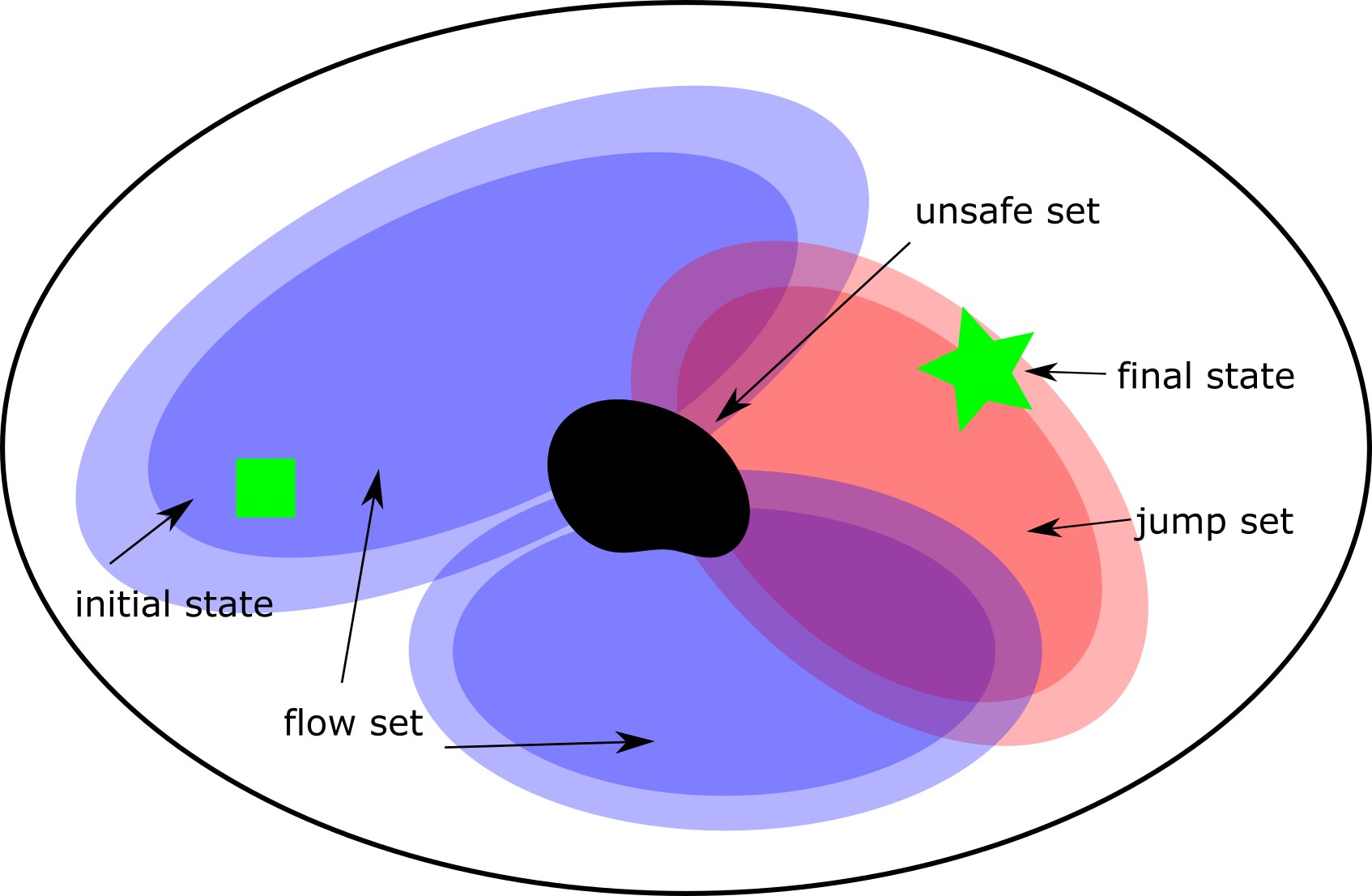
Formulated a unified motion planning framework for hybrid dynamical systems using a hybrid equation framework, enabling reasoning about motion planning tasks under different specifications and complex dynamics constraints within a single problem-data structure.
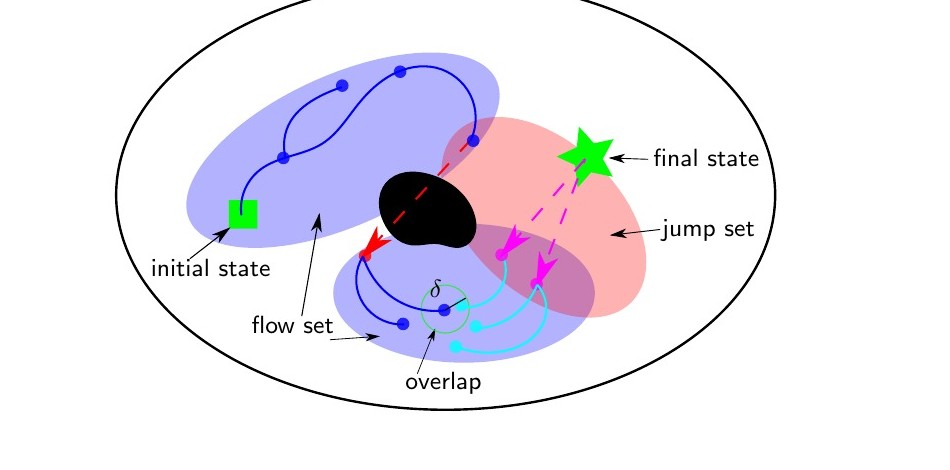
Achieved an average 77.0% improvement in computational time and 80.1% reduction in vertex creation over standard RRT through bidirectional forward–backward propagation, demonstrated on bipedal robots and an actuated bouncing ball.
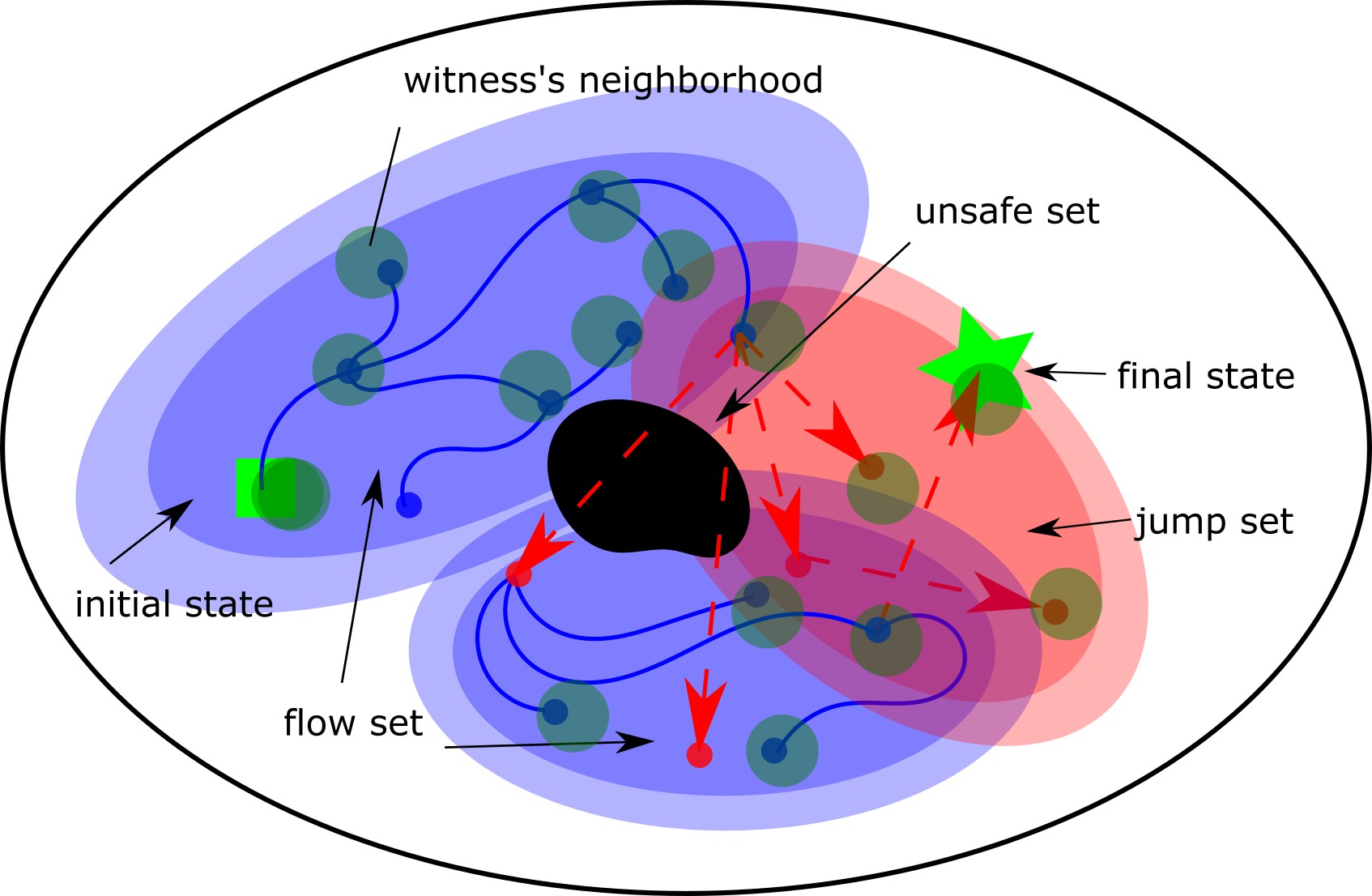
Improved computation time by 82.1% and vertex creation by 77.0% through vertex sparsification, with proven asymptotic near-optimality, demonstrated on collision-resilient aerial vehicles.
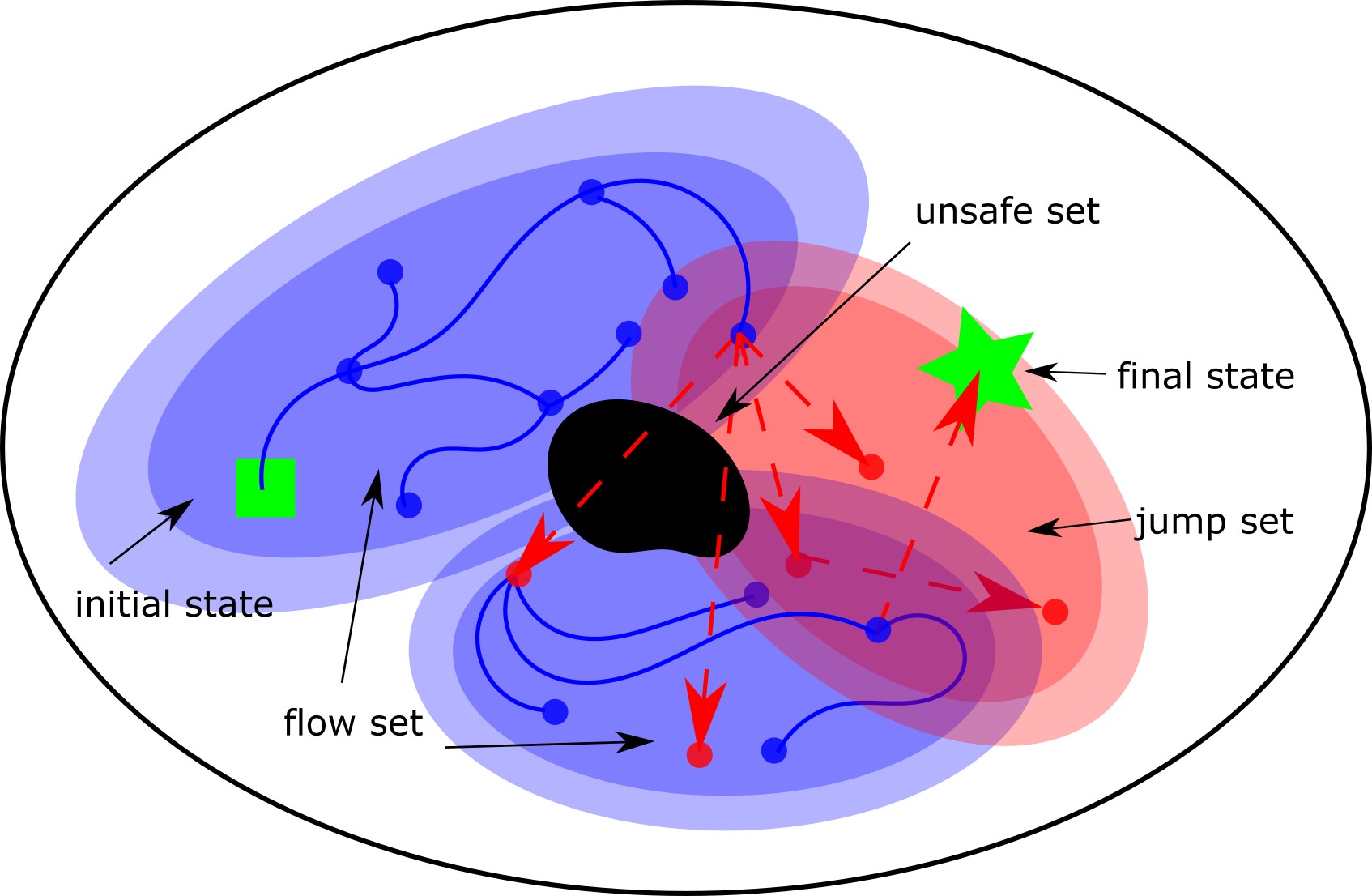
An RRT-based algorithm specifically designed for hybrid systems with proven probabilistic completeness, achieving a 95.5% performance improvement. Integrated into OMPL; the C++ implementation runs in 251 ms on a 6-D walking-robot problem (vs. 54.7 s in MATLAB).

Open-source C++ implementations of HyRRT and HySST in OMPL/ROS, illustrated on a modified pinball game and a collision-resilient tensegrity multicopter.
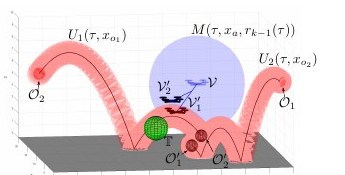
A receding-horizon planner for quadrotors that builds a safe mobility set from reachable sets of obstacles with hybrid dynamics, selecting the lowest-cost trajectory while avoiding moving obstacles with uncertain velocities.
Control Theory & Robotics Applications
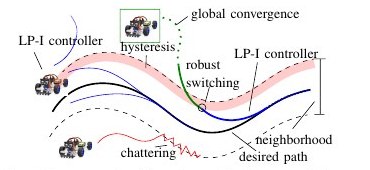
A hybrid framework combining a local path-invariant controller (via control Lyapunov and control barrier functions) with a global tracking controller, guaranteeing global convergence, path invariance, and robustness to sensor noise.
A switched reference governor that toggles between a fast oscillating RG and a slow non-oscillating RG to achieve fast and non-oscillating convergence under state and input constraints, with established recursive feasibility and strong robustness. Work conducted during my internship at MERL.
Autonomous Driving
A novel trajectory planning algorithm leveraging fluid-flow field information for smooth navigation, reasoning about traffic scenarios from a Computational Fluid Dynamics (CFD) perspective. Two patents granted.
Open-Source Contributions
Developed and integrated tendon-driven dexterous hand models into the official repository, enabling reproducible research for robotic manipulation used by academic and industry researchers worldwide.
Implemented dexterous manipulation environments, RL training modules, and simulation tooling widely used for benchmarking reinforcement learning algorithms.
Added the HyRRT and HySST algorithms into one of the most widely used open-source motion-planning frameworks in robotics research, providing accessible implementations of hybrid-systems motion planners for the global community.
Selected Publications
- , R. Sanfelice. “Motion Planning for Hybrid Dynamical Systems: Framework, Algorithm Template, and a Sampling-based Approach.” The International Journal of Robotics Research (IJRR), 2025.
- , R. Sanfelice. “HyRRT-Connect: A Bidirectional Rapidly-Exploring Random Trees Motion Planning Algorithm for Hybrid Systems.” 8th IFAC Conference on Analysis and Design of Hybrid Systems (ADHS), 2024.
- , S. Di Cairano, R. Sanfelice. “A Switched Reference Governor for High Performance Trajectory Tracking Control under State and Input Constraint.” American Control Conference (ACC), 2024.
- , R. Sanfelice. “HySST: An Optimal Motion Planning Algorithm for Hybrid Dynamical Systems.” 62nd IEEE Conference on Decision and Control (CDC), 2023.
- , R. Sanfelice. “A Rapidly-Exploring Random Trees Motion Planning Algorithm for Hybrid Dynamical Systems.” 61st IEEE Conference on Decision and Control (CDC), 2022.
- , A. Akhtar, R. Sanfelice. “A Safe Hybrid Control Framework for Car-like Robot with Guaranteed Global Path-Invariance using Control Barrier Function.” Submitted to 9th IEEE Conference on Control Technology and Applications (CCTA), 2025.
- B. Xu, , R. Sanfelice. “cHyRRT and cHySST: Two Motion Planning Tools for Hybrid Dynamical Systems.” IEEE 21st International Conference on Automation Science and Engineering (CASE), 2025.
- A. Ames, , R. Sanfelice. “A Set-based Motion Planning Algorithm for Aerial Vehicles in the Presence of Obstacles Exhibiting Hybrid Dynamics.” 6th IEEE Conference on Control Technology and Applications, 2022.
- , M. Song, J. Wang, T. Gordon. “A Flow-field Guided Method of Path Planning for Unmanned Ground Vehicles.” 56th IEEE Conference on Decision and Control, 2017.
- M. Song, , T. Gordon, J. Wang. “Flow-field Guided Steering Control for Rigid Autonomous Ground Vehicles in Low-speed Manoeuvring.” Vehicle System Dynamics, vol. 57, no. 8, pp. 1090–1107, 2019.
- M. Song, , J. Wang, T. Gordon. “A Fluid Dynamics Approach to Motion Control for Rigid Autonomous Ground Vehicles.” 25th IAVSD International Symposium on Dynamics of Vehicles on Roads and Tracks, 2021.
Posters & Presentations
- HyRRT / HySST: Sampling-based Motion Planning Algorithms for Hybrid Dynamical Systems — IROS 2023, Detroit.
- Motion Planning for Hybrid Dynamical Systems — 16th Annual Graduate Research Symposium, UC Santa Cruz, 2020.
- Motion Planning for Hybrid Dynamical Systems — Bay Area Robotics Symposium, 2019.
- Hybrid RRT: Motion Planning for Hybrid Dynamical Systems — 4th Annual NorCal Control Workshop, 2022.
Misc
Awards
- Cyber-physical Systems Research Center 2025 Best Dissertation Award, UC Santa Cruz
- Chancellor's Fellowship, UC Santa Cruz
Academic Service
- Member, IEEE Control Systems Society Technical Committee on Hybrid Systems
- Journal reviewer: IEEE Transactions on Automatic Control, IEEE Control Systems Letters, IEEE Robotics and Automation Letters
- Conference reviewer: IEEE CDC (2019–2023), ACC (2020/2022/2024), ICAR (2021/2023), CCTA (2022/2023)
Teaching Assistance
- CSE 201 — Analysis of Algorithms
- CSE 181 — Database Systems
- CSE 13S — Computer Systems and C Programming
- Robot Automation